As a senior economics major at American University, hailing from Oak Park, Illinois, I find myself reflecting deeply on the recent political strategies employed by the Democratic Party. Born in October 2004, my family’s political journey took a significant turn that same year. After years of aligning with Democratic values, the 2004 election marked a pivotal moment when we decided to vote Republican—a decision that has since become a defining aspect of our political identity.
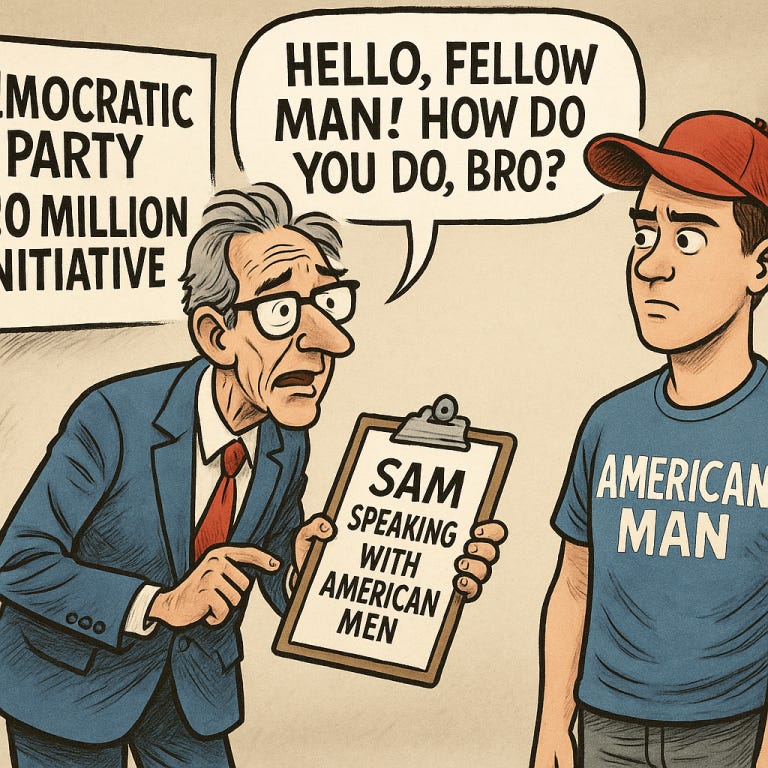
Fast forward to 2025, the Democratic Party has announced a $20 million initiative titled “Speaking with American Men: A Strategic Plan” (SAM), aiming to reconnect with male voters, particularly young men, after noticeable losses in the 2024 election. This initiative seeks to study the language and content that resonates with male voters, even suggesting outreach through platforms like video games. San Francisco Chronicle
A Disconnect Between Strategy and Substance
The SAM initiative, while well-intentioned, seems to underscore a broader issue: a disconnect between the Democratic Party’s strategies and the substantive concerns of male voters. Rather than addressing core issues such as economic stability, job opportunities, and educational access, the focus appears to be on modifying messaging tactics. This approach risks overlooking the fundamental reasons why many men feel alienated from the party. ( https://nypost.com/20265/05/27/opinion/the-secret-to-saving-democrats-20-million-stop-trashing-men/
Critics within the Democratic Party have also expressed concerns. Former campaign staffers have labeled the approach as out-of-touch and patronizing, emphasizing the need for genuine engagement over superficial strategies.
Economic Realities and Political Choices
From an economic standpoint, young men today face numerous challenges: rising student debt, a competitive job market, and concerns about long-term financial security. These issues demand comprehensive policy solutions rather than targeted advertising campaigns. The emphasis should be on creating tangible opportunities and addressing systemic barriers that hinder economic advancement.
In the 2024 election, data indicated a significant shift among male voters towards Republican candidates, with many citing economic concerns as a primary factor. This trend suggests that policy positions, more than messaging strategies, influence voting behaviors.Wikipedia
The Importance of Authentic Engagement
Authentic engagement requires more than studying language patterns; it necessitates listening to constituents’ concerns and developing policies that address their needs. Efforts to connect with male voters should involve dialogues that consider their experiences and perspectives, fostering a sense of inclusion and representation within the political process.
Reflecting on Personal and Collective Political Journeys
My family’s political shift in 2004 was driven by a desire for policies that aligned more closely with our values and concerns. This decision was not about party loyalty but about seeking representation that resonated with our lived experiences. Similarly, the current political landscape calls for parties to move beyond strategic rebranding and towards substantive policy development that genuinely addresses the electorate’s needs.
Conclusion
The Democratic Party’s $20 million SAM initiative highlights the challenges of reconnecting with a demographic that feels increasingly marginalized. While understanding communication styles is valuable, it should not overshadow the imperative to develop and implement policies that address the real and pressing concerns of male voters. Authentic engagement, grounded in substantive policy solutions, is essential for rebuilding trust and fostering a more inclusive political discourse.