

The War on Data Centers
Economic self-destruction dressed up for a MIMBY primary electorate - by Carter McKay

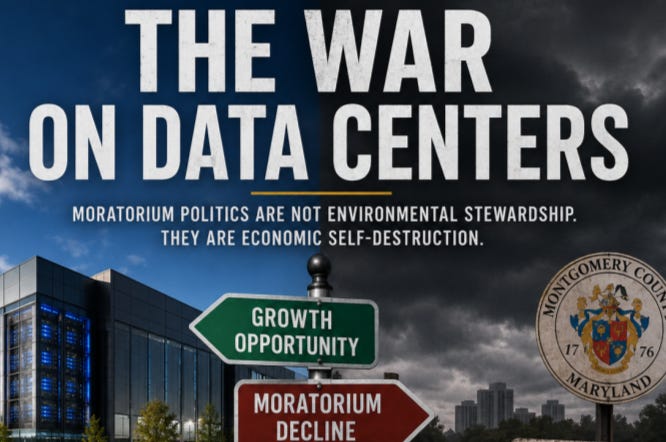
Moratorium politics are not environmental stewardship. They are economic self-destruction dressed up for a NIMBY primary electorate.
The American economy runs on electrons, ambition, and the quiet hum of servers doing work most people never see. Data centers are as essential to modern life as highways were to the post-war boom. Strip them away, restrict their growth, drive them to friendlier jurisdictions, and you do not protect your community. You impoverish it. Montgomery County, Maryland, is learning this lesson the hard way, though its political class seems determined to fail the course.
County Councilmembers Evan Glass and Will Jawando have decided that the surest route to the Democratic primary ballot for county executive is to declare open war on digital infrastructure. Glass proposes a six-month moratorium on new data center permits. Jawando raises the ante with two full years. Neither man has explained, with any specificity, what economic engine they intend to replace the lost investment. Neither has answered what happens to the county’s commercial tax base when capital relocates to Loudoun County or Prince George’s or Raleigh. They have not answered because they do not intend to. The answers would be inconvenient.
This is the Karl Rove definition of a political trap dressed in environmental clothing. You identify a target most voters do not fully understand. You attach it to fears they already carry. You repeat the message until it crowds out every competing fact. Then you hold a rally. It works brilliantly as campaign strategy. It is catastrophic as governance.
THE ENERGY ARGUMENT COLLAPSES UNDER SCRUTINY
The energy crisis argument is the most intellectually dishonest piece of the moratorium case. Glass and Jawando want voters to believe that a handful of proposed server facilities are driving up electricity bills across the region. The claim is convenient. It is also false.
Maryland’s electricity prices have been rising for years because state leaders chose an energy strategy built on ideological preference rather than engineering reality. Reliable baseload generation has been phased out or discouraged. Nuclear expansion stalled under political pressure. Natural gas infrastructure became a cause of activist opposition rather than a pillar of grid stability. Renewable mandates expanded faster than the transmission and storage technology needed to support them could be deployed. The result is the entirely predictable outcome any first-year economics student could have forecast. Supply contracted. Demand grew. Prices climbed. That trajectory was well underway before any data center broke ground in Montgomery County.
Blaming server farms for Maryland’s grid failures is the political equivalent of blaming automobile traffic for a road that was never properly built. The infrastructure problem predates the demand problem. The politicians now attacking data centers are in many cases the same politicians who built the energy policy that created grid vulnerability in the first place. They supported the mandates. They cheered the retirements of baseload plants. They treated natural gas as an enemy rather than a bridge fuel. And now they stand at rallies warning about electricity costs, as though they had nothing to do with creating them.
Accountability, apparently, is for someone else.
Blaming server farms for Maryland’s grid failures is the political equivalent of blaming traffic for a road that was never properly built.
VIRGINIA MADE A DIFFERENT CHOICE
Virginia made a different choice. Loudoun County looked at the data center industry and saw what it actually is: a long-term commercial tax anchor that generates enormous public revenue without placing heavy demands on schools, social services, or residential infrastructure. The county embraced responsible development, built the regulatory frameworks to manage it, and reaped the rewards. Today Northern Virginia hosts one of the largest data center ecosystems on the planet. Businesses moved in. Jobs followed. Tax revenues grew. Roads got funded. Emergency services got funded. Schools got funded.
That is the outcome Montgomery County is actively choosing to forgo.
The contrast matters not as an abstract geographic comparison but as a concrete illustration of consequences. Capital is mobile. It moves toward clarity and predictability. It retreats from regulatory hostility and political uncertainty. Every moratorium announcement, every rally soundbite warning about server farms and the Potomac River, sends a signal to every technology company, real estate developer, and infrastructure investor evaluating their options. The signal reads: go somewhere else.
Some will. Many already have. And the revenue they would have generated, the jobs they would have created, the commercial tax base that would have helped relieve pressure on residential homeowners, all of that goes with them.
THE ENVIRONMENTAL POSE
The environmental framing deserves direct and honest examination, because legitimate environmental protection is a serious responsibility. Jawando warned at a rally that “we can’t get back clean water once it’s gone.” The sentiment is unobjectionable. The application is misleading.
The Potomac River watershed faces genuine environmental stressors. Aging sewer infrastructure. Urban and agricultural runoff. Decades of stormwater management failures. Population growth outpacing treatment capacity. These are real, long-standing challenges that have received sustained attention from environmental advocates, researchers, and regulators for years. To suddenly position proposed data centers as the defining threat to the Potomac requires a selective reading of environmental science that would embarrass a freshman ecology student.
Modern data center design has also advanced considerably. Newer facilities increasingly use closed-loop cooling systems that minimize water consumption, water recycling technologies, renewable energy procurement agreements, and sophisticated energy management platforms that reduce overall grid draw. None of that complexity fits neatly into a campaign rally narrative, so it tends to get omitted. The facts are not always useful when the goal is the headline.
Responsible environmental policy demands specificity. It demands honest identification of actual threats, serious regulatory frameworks to address them, and transparent standards that projects must meet before receiving permits. That is a legitimate and productive conversation to have. A blanket two-year moratorium is not that conversation. It is an environmental pose dressed up as an environmental policy.
A blanket two-year moratorium is not environmental policy. It is an environmental pose dressed up as one.
A NATIONAL SECURITY DIMENSION GOES UNSPOKEN
There is a dimension to this debate that almost never gets discussed in Montgomery County political circles, and that omission is itself revealing.
Artificial intelligence infrastructure has become a matter of national strategic competition. The United States is engaged in a genuine technology race with China across AI development, cloud computing, cybersecurity, and advanced digital systems. Data centers are not corporate amenities. They are now foundational infrastructure for economic competitiveness, military logistics, intelligence operations, and the technological systems that underpin national security. The federal government, the Department of Defense, and the intelligence community all depend on robust, proximate, and reliable digital infrastructure.
Montgomery County sits at the center of one of the most strategically significant technology corridors in the world. Federal agencies, defense contractors, cybersecurity firms, and AI research institutions cluster throughout the region. The infrastructure that supports their work matters enormously. Local politicians treating data centers as though they were cigarette factories from 1958 are not engaging with the national security realities of 2025. They are engaged in a performance for a primary electorate that finds industrial development aesthetically distasteful.
That is not serious governance. It is nostalgia dressed up as progressivism.
A COUNTY CONSUMING ITS OWN ADVANTAGES
Montgomery County already carries a long list of self-inflicted competitive disadvantages. Slow and unpredictable permitting processes. Excessive regulatory burdens that make development expensive and uncertain. A political culture that treats commercial growth with instinctive suspicion. Office vacancy rates that have climbed steadily as employers seek more welcoming jurisdictions. A pattern of taxpayer outmigration that should alarm every elected official who has read a budget projection.
The county has real and genuine strengths. An exceptionally educated workforce. Proximity to the nation’s capital and its enormous concentration of federal institutions. World-class research universities and medical centers within commuting distance. A diverse professional community with deep expertise across multiple sectors.
Those advantages are real. They are also not permanent. Competitive advantages erode when the policy environment makes them hard to monetize. Educated workers move to jurisdictions where the economy offers them opportunity. Employers follow talent. Investors follow employers. The cycle of decline does not announce itself with a single dramatic event. It accumulates, quietly, one rejected permit and one departing business at a time.
Montgomery County is in the middle of that accumulation. The moratorium movement is another chapter in a long story of choosing ideological posture over economic competitiveness.
THE CHOICE STILL AVAILABLE
The question is not really about data centers. It never is, when you trace these debates to their roots. The question is whether Montgomery County believes it is still a place where major economic development is welcome. Whether it intends to compete for the industries that will define the next generation of prosperity. Whether its elected officials can separate legitimate environmental stewardship from convenient election-year theater.
The answer, based on current evidence, is not encouraging.
Glass and Jawando are competing for applause from an activist base that views economic growth as a problem to be managed rather than an opportunity to be seized. They are offering moratoriums where they should be offering smart regulatory frameworks. They are staging rallies where they should be sitting across the table from investors, engineers, and county planners to develop the standards that would allow responsible development to proceed.
Smart policy is harder than a moratorium. It requires actual governance, actual expertise, and actual willingness to make difficult tradeoffs. It does not generate the same applause at the rally. But it is the difference between a county that grows and one that slowly, steadily, loses ground to jurisdictions that decided growth was worth the effort.
Virginia made that decision years ago. The results speak for themselves.
Montgomery County can still make a different choice. But every moratorium announcement, every data center rally, every signal that capital is unwelcome here makes that choice more difficult and less likely.
Jurisdictions that punish investment eventually stop receiving it. That is not a political opinion. It is an economic fact as old as commerce itself.
Also See:
Why Virginia Gets Data Centers—and Maryland Gets Tax Hikes

White’s Ferry across the Potomac was the shortest distance between Poolesville, Maryland, and Leesburg, Virginia. Now, it’s the perfect metaphor. When the ferry shut down operations in 2020, the trip from Montgomery County’s Agricultural Reserve to Loudoun County’s Data Center Alley got 40 minutes longer.
ENDNOTES
1. Montgomery County Councilmembers Propose Data Center Moratoriums. The Baltimore Banner. Coverage of Glass and Jawando moratorium proposals during the Democratic primary race for county executive, 2025. https://www.thebanner.com/politics-power/local-government/data-center-moratorium-glass-jawando-school-resource-officer-IZPXJ2O3DVDYZHHVWVTZKNSFSI/
2. PJM Interconnection: 2024 Capacity Market Results and Grid Reliability Outlook. PJM Interconnection LLC. Official capacity auction results and reliability planning documentation for the Mid-Atlantic power grid. https://www.pjm.com/markets-and-operations/rpm
3. Maryland Renewable Portfolio Standard: Program Overview. Maryland Energy Administration. Overview of the state’s renewable portfolio standard mandates and timeline. https://energy.maryland.gov/Pages/residential/renewable-energy-options.aspx
4. Data Centers and the American Power Grid: Demand Projections 2024-2030. International Energy Agency. Analysis of global and regional data center electricity demand growth. https://www.iea.org/reports/electricity-2024
5. Loudoun County, Virginia: Data Center Economy Impact Analysis. Loudoun County Government. Official economic impact data on the county’s data center industry, including commercial tax contributions. https://www.loudoun.gov/datacenters
6. Northern Virginia Technology Council: Data Center Industry Profile. Northern Virginia Technology Council. Industry profile and economic contribution data for the region’s data center sector. https://www.nvtc.org/press-releases/new-nvtc-report-virginia-data-centers-drive-40-billion-in-statewide-economic-impact/
1Carter McKay is a contributing commentator for Direct Line News Magazine, covering economic policy, regulatory affairs, and political accountability in the Mid-Atlantic region.