


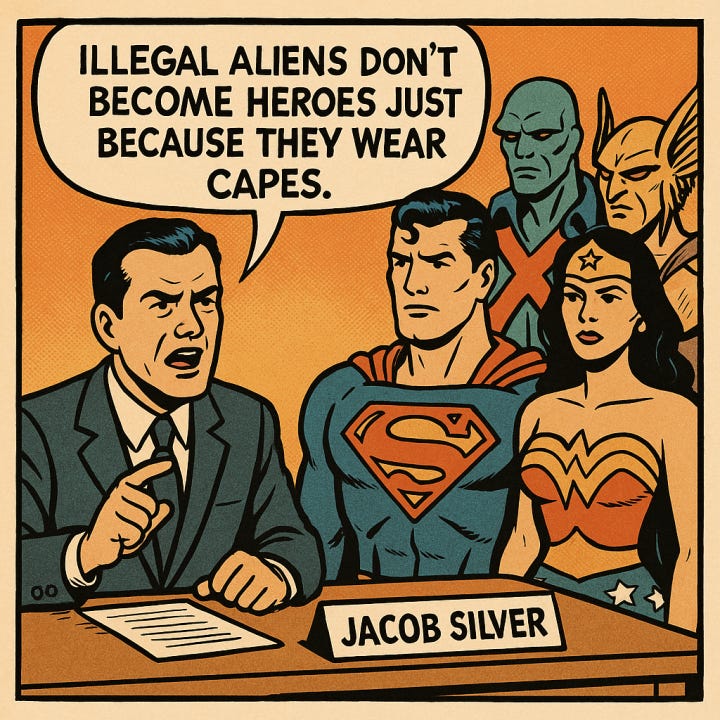
Last night I did what every red-blooded American comic nerd and cinephile did: I went to see the latest Superman movie—James Gunn’s grand reboot of the Man of Steel. You know, the one he’s been hyping for months like it’s the Second Coming of Kal-El himself. And while I was prepared for lasers, capes, and Jonathan Kent’s folksy wisdom, I wasn’t prepared for this much immigration propaganda dressed in spandex.
Because, folks, we need to talk. We need to talk about Superman. We need to talk about Martian Manhunter. About Wonder Woman. About Hawkman. Hawkgirl. Starfire. The Green Lantern Corps. And how, under James Gunn’s visionary eye, they’ve all become something a little more… political. A little more symbolic. A little more like a glowing endorsement of open borders wrapped in the American flag.
Let’s get this straight: Superman is an illegal alien. So are most of his Justice League friends. And if you thought this new movie was going to treat that fact with a bit of humility, maybe even acknowledge the complicated nuances of being an outsider in a nation of laws, then you’re in for a rude awakening. Because Gunn doesn’t just double down—he celebrates it.
Superman: The Undocumented Messiah
It’s no secret that Kal-El is an alien. That’s been canon since 1938. The last son of Krypton crash-lands in Kansas, gets adopted by the Kents, grows up into America’s Boy Scout, and becomes a symbol of truth, justice, and—nowadays—whatever the politically fashionable version of “the American way” happens to be.
But here’s the thing: Superman didn’t go through immigration screening. No asylum process. No refugee vetting. Not even a space-themed green card. If he landed in 2025 instead of the 1930s, he’d be met with border patrol drones, a media circus, and probably a congressional investigation.
Yet James Gunn wants us to treat him as a role model—a cosmic DACA poster child in tights.
And don’t tell me “He’s just a metaphor.” Because that’s exactly the problem. In Gunn’s version, Kal-El doesn’t just fight for humanity—he represents all immigrants. Illegal or not. The movie all but shouts: “If you’re against Superman, you’re against immigrants.”
Which leads us to the uncomfortable question that James Gunn doesn’t want you to ask…
Was Lex Luthor Actually Right?
Let’s talk about our bald, power-hungry nemesis: Lex Luthor. The guy’s always been framed as a megalomaniac, a billionaire with a god complex. But maybe—just maybe—he was onto something.
Luthor looked at Superman and saw danger. Not a savior. Not an immigrant. A threat. An all-powerful being not bound by human laws, human morality, or human accountability. And he asked the one question no one else would:
“What if one day he decides Earth isn’t worth saving?”
In Gunn’s reboot, this question is dismissed as paranoia. But let’s be real: That’s not xenophobia. That’s just prudence. If an unregistered alien—capable of melting tanks with his eyes—moves into your neighborhood, shouldn’t you be at least a little concerned?
Lex wasn’t wrong. He just had a branding problem.
Same goes for Cadmus—DC’s shadowy government program tasked with monitoring metahuman threats. They were vilified in the Justice League Unlimited series for developing contingency plans. But when you’ve got aliens like Martian Manhunter who can read every mind on Earth while shapeshifting into the Pope, maybe it’s not crazy to have a Plan B.
Martian Manhunter: ICE’s Worst Nightmare
Speaking of J’onn J’onzz—aka Martian Manhunter—he’s got a compelling backstory. His planet was destroyed. He’s the last of his kind. He just wants peace. I get it. I feel for him.
But that doesn’t change the fact that he assumed a fake identity, infiltrated Earth’s institutions, and operated as a government agent without ever disclosing his alien origin. Dude’s been on Earth since the ‘50s and still hasn’t filled out a W-4 under his real name.
If that isn’t a cosmic-level visa violation, I don’t know what is.
Diana Prince: Amazonian Royalty on a Tourist Visa?
Now, let’s move on to Wonder Woman. Diana’s not from outer space—but she’s still not from here. She’s royalty from a secret, isolationist island that doesn’t pay UN dues or share trade routes. Yet somehow she ends up working at the Smithsonian with full access to classified intel and an Amazonian sword in her purse.
How’d she get past airport security? Did she list “demigoddess” on her job application?
And Hawkman? Hawkgirl? Reincarnated Thanagarian warriors with alien Nth-metal strapped to their chests. How did Carter Hall qualify for naturalization? I don’t recall seeing a comic book arc where he applies for citizenship or sits for the civics test. (“Who was the first President of the United States?” “I fought beside him in 1776.”)
James Gunn conveniently forgets all this in favor of feels over facts. He wants us to believe that being an alien—legal or not—is automatically virtuous. That illegal presence = moral superiority. That enforcement = bigotry.
But Jacob, They Didn’t Take Benefits!
My cousin Jimmy—bless his sweet, PB&J-eating soul—told me last night after the movie, “Well, Superman didn’t take welfare. He had a job.”
Yes, Jimmy. Thank you. Superman did work at the Daily Planet. Diana did have a Smithsonian gig. J’onn did try to contribute. But that’s not the point.
The point is they bypassed the system. They operated outside it. They didn’t wait in line. They didn’t apply for status. They just showed up and assumed everyone would accept them because, hey, they save people.
But imagine if that logic applied in real life:
“Sure, I crossed the border illegally, but I helped an old lady carry groceries.”
“Yes, I overstayed my visa, but I saved a cat from a tree.”
Is that how the rule of law works now? Is heroism a substitute for documentation?
Because if it is… then by James Gunn logic, General Zod deserves a fair hearing.
Welcoming Darkseid: The Logical Conclusion of Gunnism
Let’s push this to its absurd conclusion. If we accept that all aliens are welcome—that anyone who lands here has a right to stay—then we’re not just opening the door to Superman.
We’re rolling out the red carpet for Darkseid.
Darkseid, lord of Apokolips, genocidal tyrant, harbinger of the Anti-Life Equation. He wants to conquer Earth. Enslave us. Replace free will with total submission.
But hey—he’s not from here. So under the new morality of James Gunn’s DC, don’t we have to hear him out?
Maybe Darkseid just needs economic opportunity.
Maybe General Zod’s Kryptonian martial law is a “cultural perspective.”
Maybe Brainiac’s plan to shrink cities is just misunderstood urban planning.See the problem?
Comic Book Logic ≠ Real-World Policy
Let me be clear: I love superhero stories. I’ve spent way too much money on graphic novels and movie tickets. I’ll defend Clark Kent’s heart, J’onn J’onzz’s empathy, and Diana’s bravery any day.
But fiction is not policy. And symbols are not substitutes for laws.
We live in a real world where unchecked immigration strains social services, erodes security, and undermines the very system that allows people to succeed legally.
America welcomes immigrants. We always have. But we welcome them through a process. Through law. Through earned trust.
Superman never went through that process. Neither did the rest of the alien squad. And James Gunn’s reboot? It’s basically a 120-minute TED Talk on how “borders are bad and laws are mean.”
Sorry, Jimmy Gunn. We already have enough real-world issues. We don’t need Kal-El lecturing us about immigration while dodging missiles and monologuing in a wheat field.
Heroes Could’ve Followed the Law
Here’s a fun little nerd nugget: U.S. immigration law has clauses that could’ve helped these heroes stay legally.
Special Immigrant Status for individuals of extraordinary ability? Clark Kent could’ve qualified.
Refugee protections for survivors of planetary genocide? Martian Manhunter says hello.
Diplomatic immunity for foreign royals? Diana’s got that covered.
But not once in the comics—or the movies—do we see these heroes actually use the system. Not once does Carter Hall file naturalization papers. Not once does Diana stand in line at USCIS. Not once does Kal-El submit biometric data.
They just show up. And we’re expected to be grateful.
Well… I want a scene where Superman goes through a background check and gets fingerprinted like everyone else.
Were the Real Heroes the “Villains”?
So maybe… just maybe… we owe Lex Luthor and Project Cadmus an apology.
Maybe the “villains” were just realists.
They didn’t hate Superman. They feared what could happen if power went unchecked. They saw a future where interstellar deities rewrite human law on a whim. They saw a threat—and they acted.
That’s not villainy. That’s accountability.
In the end, the line between fiction and propaganda is thinner than ever. And James Gunn’s Superman isn’t just a story. It’s a statement.
A statement that says: “If you enforce the law, you’re the bad guy. If you break it for noble reasons, you’re a hero.”
I reject that.
So here’s my final thought, straight from the Fortress of Solitude of Common Sense:
Illegal aliens don’t become heroes just because they wear capes.
And enforcing borders doesn’t make you Lex Luthor.
It makes you sane.
Endnotes:
“Superman” (2025) directed by James Gunn premiered nationwide last night and has been positioned as a soft reboot for the DC Cinematic Universe.
Kal-El’s illegal entry into Earth has never been addressed legally in DC Comics continuity, though he’s often metaphorically linked to immigrants.
Martian Manhunter assumed human identity for decades without legal process.
Cadmus and Lex Luthor’s mistrust of Superman is a recurring theme in both the comics and animated series, often portrayed as paranoia, but rooted in real concerns about unchecked power.
Darkseid first appeared in Superman’s Pal Jimmy Olsen #134 (1970) and represents totalitarianism and control, often used as a metaphor for anti-liberty governance.
Current U.S. immigration laws include “extraordinary ability” visas (EB-1), asylum status, and other legal pathways rarely acknowledged in superhero narratives.
Jacob Silver is a Contributor for Direct Line News and can be contacted at Jacob.Silver@mcgopclub.com.